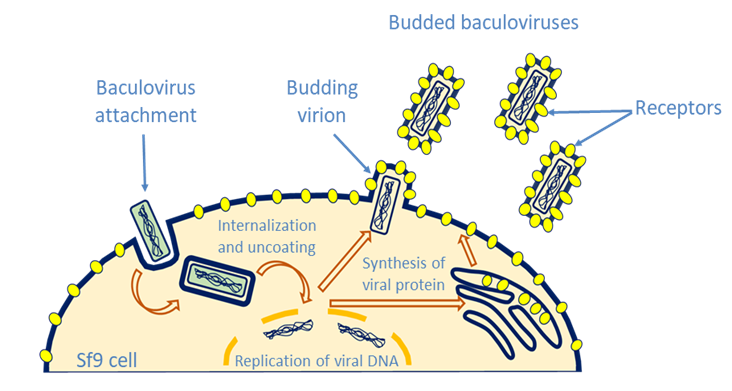
Baculovirus expression vector systems and budded baculovirus particles
For producing the protein of interest the Sf9/baculovirus expression system is used. Insect cells are infected with a recombinant baculovirus in which a gene for viral protein polyhedrin is replaced with a gene of interest. The expressed GPCRs are found on the membrane of Sf9 cells. Furthermore, it has been shown that membrane proteins expressed on the surface of Sf9 cells also bud with baculoviruses and remain on their surface. Budded baculovirus particles (BBVs) can be considered as an essentially soluble cell-free system in which membrane proteins, including GPCRs, are displayed on the surface of BBVs in their native conformation and environment.
Work with baculoviruses could be conducted in Biosafety Level 1 conditions (they are neither hazardous for the environment nor dangerous for humans), which considerably simplifies the handling and maintenance of baculovirus/insect cell system. Cost-effective, high expression level and large scale production possibilities make this system a highly attractive tool for the assessment of receptor-ligand binding interactions.
We have applied both BBVs and membrane preparations from baculovirus infected Sf9 cells for characterization of the dynamics of ligand binding to various GPCRs by an radioligand binding assay (Allikalt&Rinken 2017) or fluorescence anisotropy (FA) based assay (Veikšina et al. 2010, Mazina et al. 2013, Veikšina et al. 2014, Veikšina et al. 2015, Link et al. 2017). Although good experimental conditions can be achieved in FA-based assays with Sf9 cell membrane preparations, it cannot be considered a homogenous assay system – the membrane preparation is a mixture of lipoparticles of different shapes and sizes that range from a few tens of nanometers to more than a micrometre in diameter. Additionally, the orientation of receptor proteins within these lipoparticles is a controversial issue with limited control. However, in case of the application of BBVs the initial isotropic conditions, where all the receptor spatial orientations are present and evenly distributed in the reaction’s medium, are primarily fulfilled.